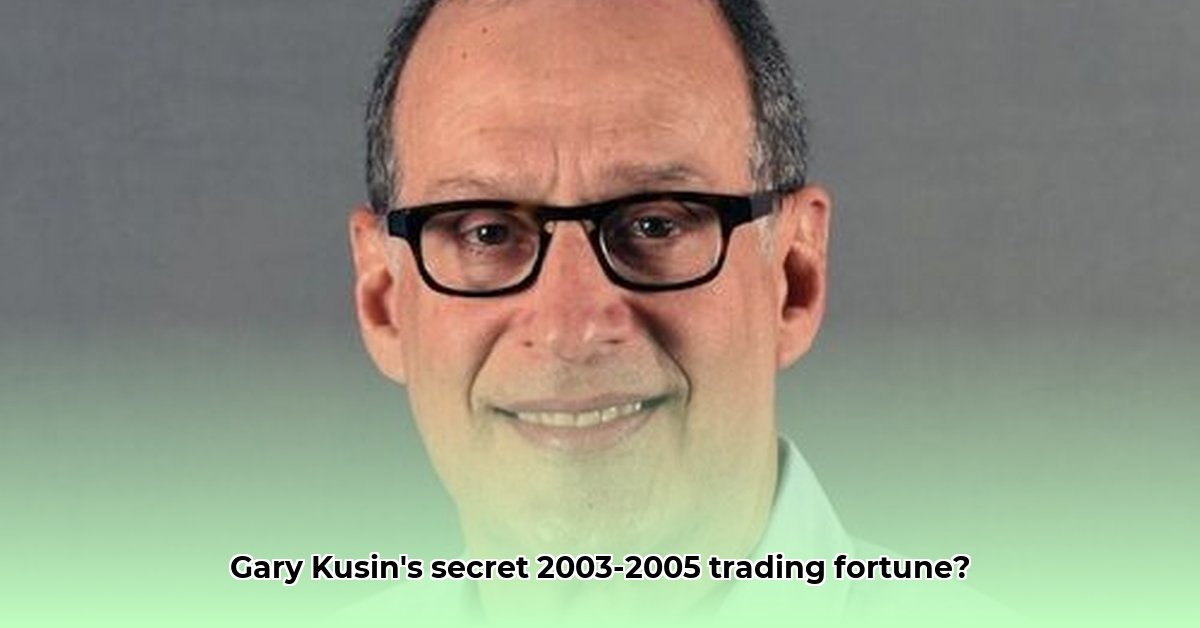
Gary Kusin Net Worth: A Deep Dive into 2003-2005 Trading Activity
Estimating Gary Kusin's net worth requires careful consideration of his trading activities between 2003 and 2005. While precise figures remain elusive due to data limitations, estimates place his net worth around $2.56 million during this period, accumulated through investments in diverse sectors, including shipping, electronics, travel, and entertainment. This analysis explores the available information, highlighting both what we know and, crucially, what remains unknown. Understanding the limitations of the available data is paramount for a balanced assessment. How did he achieve this level of wealth in such a short timeframe? Let's examine the available clues.
Deconstructing Kusin's Trading Strategy: 2003-2005
Reports indicate June was consistently a period of heavy trading activity for Kusin. The years 2003 and 2005 stand out for their intense trading volume, suggesting a potentially active, short-term trading approach rather than a long-term buy-and-hold strategy. However, the lack of transactional data prevents definitive conclusions. Were these short-term trades highly successful, or did they involve significant risks? This question remains unanswered without access to more detailed transaction records.
Understanding the Gaps in Available Data
The biggest hurdle is the scarcity of detailed financial information. Missing pieces of the puzzle include the rationale behind individual investment choices, the holding periods for each asset, the impact of dividend reinvestments, and the effects of capital gains taxes. This absence of crucial data significantly limits our ability to construct a clear picture of his returns and risk-adjusted performance. Without this information, any estimate of his net worth is inherently an approximation with a considerable margin of error.
What We Can Infer From Limited Data
Despite the data limitations, some inferences can be made. Kusin displayed a remarkably diversified investment portfolio, spanning various sectors. The concentrated trading activity in June each year suggests a planned approach, but the exact nature of this strategy remains unknown. Did this diversification approach effectively mitigate risk? We can only speculate until more complete data is available.
Analyzing Gary Kusin's Investment Strategy: A Framework for Future Research
To build a more accurate model of his investment strategy and its risk-adjusted return, further investigation is critically needed. Financial modeling using currently available data can only suggest potential strategies, not definitive conclusions. What techniques might be employed to assess his risk-reward profile if more data were available?
The Importance of Granular Data for Comprehensive Analysis
The lack of specific information, such as exact purchase and sale prices, transaction fees, and tax implications, prevents a precise assessment of Kusin's investment returns. Did his strategies consistently outperform market benchmarks? Without granular data, this question remains unanswered. What kind of financial modeling techniques would be required to estimate the risk-adjusted returns more accurately?
The Path Forward: Filling in the Gaps
A comprehensive understanding of Gary Kusin's net worth and investment strategy requires access to more detailed information. Potential avenues for future research include:
- Public Records: Scrutinizing publicly available financial records could provide additional data points.
- Advanced Financial Modeling: Sophisticated financial modeling techniques could be employed to estimate likely investment strategies.
- Interviews and Primary Sources: Gathering firsthand accounts from Kusin or those familiar with his trading activity could provide valuable insights.
Critical Considerations: Biases and Market Volatility
The information available is subject to limitations and potential biases. The data may not represent all of Kusin's financial activities. Furthermore, any analysis needs to consider the inherent unpredictability of financial markets. Past investment success is not a guarantee of future performance. How would these uncertainties and inherent market volatility affect the reliability of any conclusions drawn from the available data?
Key Takeaways:
- Determining Gary Kusin's net worth and investment returns during 2003-2005 is challenging due to data limitations.
- His trading activity indicates diversification across several sectors and concentrated trading periods.
- A comprehensive financial analysis requires access to more detailed data, including transaction records and tax information.
- The available data provides only a partial and speculative account of his investment strategies and successes.
Navigating Tomorrow: Essential Business Leadership Insights
In today’s rapidly evolving global landscape, effective business leadership transcends mere management of operations or quarterly financial targets. It’s about cultivating an environment where innovation thrives, employees feel empowered, and the organization can adapt with agility to unforeseen challenges. The modern leader understands that their role extends far beyond the boardroom, impacting company culture, talent retention, and the very long-term viability of the enterprise. True leadership now demands a blend of strategic foresight, emotional intelligence, and a genuine commitment to the growth and well-being of every team member, transforming obstacles into opportunities for collective advancement.
The most impactful leaders are not just decision-makers; they are visionaries who articulate a clear purpose and inspire collective action towards it. They prioritize transparent communication, foster psychological safety, and recognize that diverse perspectives are invaluable assets, not simply checkboxes. Furthermore, they are lifelong learners, constantly seeking new knowledge and refining their own approach, leading by example in a world that demands continuous evolution. Such leaders build resilient organizations capable of weathering storms and seizing new markets, proving that empathy and clarity of vision are just as crucial as financial acumen in achieving sustainable success.